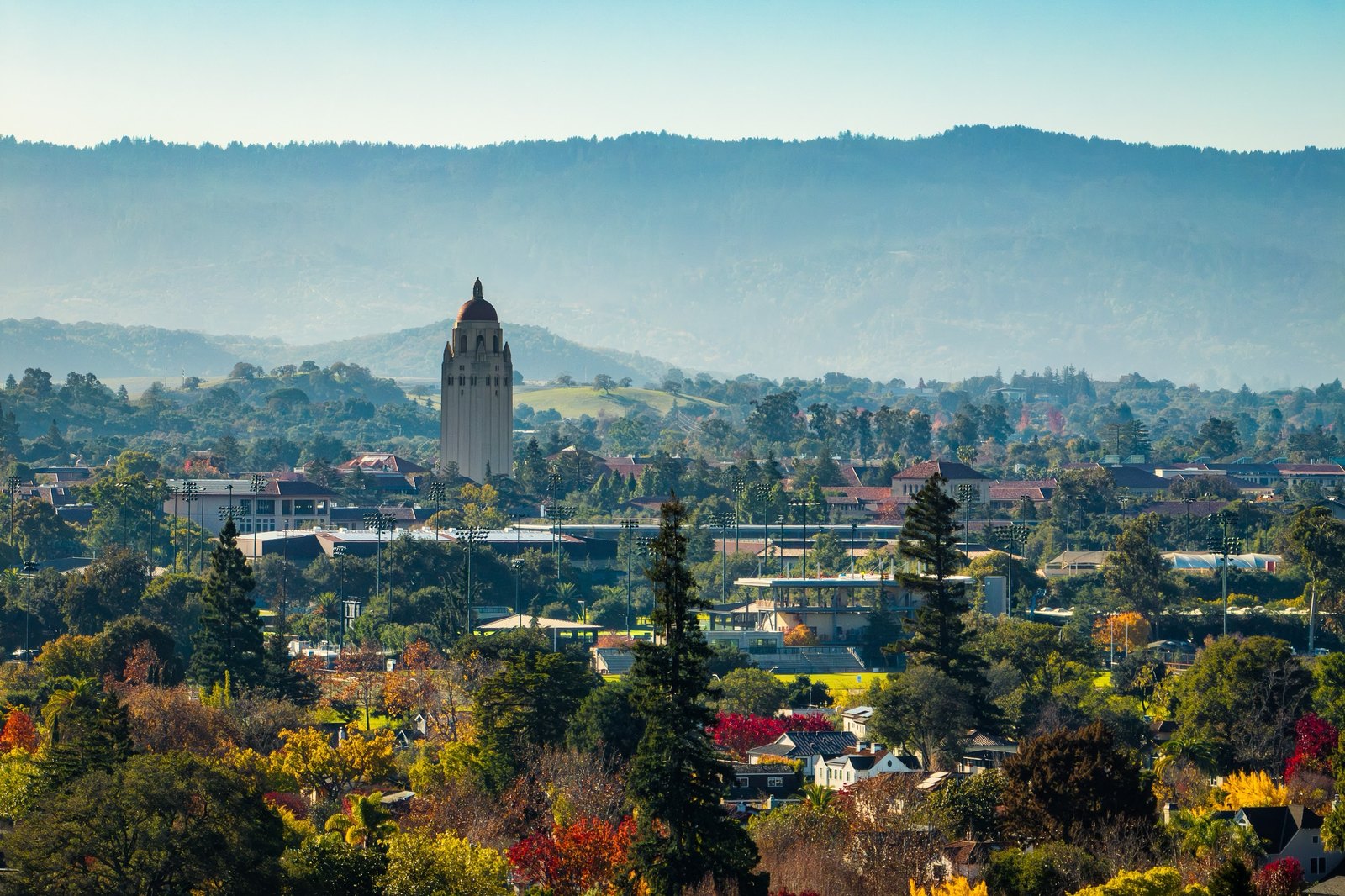
Buyers arrive in Palo Alto with a single number in their head: the citywide median. It is one of the least useful figures in Silicon Valley real estate. The city runs from the Stanford boundary to the Mountain View line and from the foothills to the Bayshore, and the difference between two homes of identical square footage — one north of Oregon Expressway, one south of it — can be substantial. Palo Alto is not a market. It is a set of markets that happen to share a city hall and a school district.
What follows is how I explain the geography to clients before we tour anything. Not to rank the neighborhoods — they serve different lives — but so that when you see a price, you know what you're actually looking at.
The north side: land, legacy, and rules
Old Palo Alto is the address most people mean when they say "Palo Alto." Large flat lots, mature street trees, deep setbacks, and a long institutional memory. Homes here trade on lot size and street as much as on the house itself, and a meaningful share of transactions are effectively land purchases with a structure attached.
Crescent Park, north of Embarcadero toward the creek, offers similar scale with a quieter, more residential feel and some of the city's most consistent architectural character. Professorville, southeast of downtown, is the oldest of them — a registered historic district of homes originally built for Stanford faculty. It is beautiful and it is regulated: the city adopted design guidelines for the district to keep new construction and exterior alterations compatible with its character. Buy there for the architecture, not for the renovation flexibility.
Community Center and Downtown North trade walkability for lot size. You are minutes from University Avenue, Rinconada Park, and the library complex, on smaller parcels with more variety in vintage and condition.
The south side: value, Eichlers, and space
Midtown is the practical center of the city — postwar ranch homes on regular lots, a genuine neighborhood commercial strip, and prices that reflect a real discount to the north side without leaving the school district. It is where a great many families actually land.
Greenmeadow, Fairmeadow, and the surrounding tracts hold Palo Alto's concentration of Eichler homes — mid-century post-and-beam houses with glass walls, atriums, and flat roofs. Eichler ownership is its own discipline: radiant slab heating, single-pane glazing, and roof systems that behave differently from conventional construction. Some of these tracts have organized around design protections precisely because a two-story addition next door changes the light and privacy the whole plan depends on.
Barron Park and Green Acres offer the largest lots on the south side, with a semi-rural texture — no sidewalks on some streets, older well infrastructure in places, and a genuinely distinct feel. College Terrace, wedged against Stanford, is compact, walkable, academic, and has its own parking program.
Three rules that decide what you can build
Once you narrow to a few streets, the questions stop being about neighborhood feel and start being about entitlement. Three items matter more than most buyers expect, and all three should be verified with the City of Palo Alto before you write an offer:
- Single-story overlays. Portions of Palo Alto carry an overlay that restricts new construction on affected lots to one story. If your plan involves a second floor, this is a threshold question, not a design detail. Overlays are parcel-specific; check the property, not the neighborhood.
- Historic districts and individual designations. Professorville is the best-known, but individually listed properties exist across the city. Designation typically means design review for exterior changes and additions — a longer timeline and a narrower set of options.
- The tree ordinance. Palo Alto protects coast live oak and valley oak at roughly 11.5 inches in diameter and coast redwood at roughly 18 inches, and removal of a protected tree requires a permit from Urban Forestry under limited conditions. A mature protected oak in the middle of your dream footprint is a design constraint, not a negotiation. The ordinance has been revised more than once in recent years, so confirm current thresholds directly.
None of these are obstacles, exactly. They are information — and they are knowable before you commit. The buyers who get surprised are the ones who fell in love with a lot and asked about the rules afterward.
How to actually run the comparison
When I underwrite a Palo Alto purchase with a client, we separate the price into three parts: land (size, shape, orientation, street), improvement (what the existing house is worth to you as-is), and optionality (what the parcel would allow you to do in five years). A house that prices high on improvement and low on optionality is a different asset from one priced the reverse — and buyers routinely pay for the first while assuming they're getting the second.
The other habit worth building: walk the block twice, once on a weekday morning and once on a weekend afternoon. Commute noise, school traffic, flight paths, and afternoon sun all show up at different hours. In a city this expensive, an hour of your time is cheap diligence.
School assignment in Palo Alto Unified is address-driven and subject to change through district boundary decisions; if schools are central to your purchase, verify assignment for the specific address with the district rather than relying on a listing or a map.
Narrowing down streets in Palo Alto?
I can tell you what a given parcel will and won't allow before you write an offer — overlays, designations, trees, and what the lot is actually worth. Reach out and we'll go street by street.
Start a ConversationSources & Further Reading
City of Palo Alto — Professorville Historic District Design Guidelines →Canopy — Palo Alto Tree Protection Ordinance Overview →City of Palo Alto — Planning & Development Services →Atherton vs. Menlo Park: A Buyer's Guide →Payne Sharpley is a Silicon Valley real estate agent with Intero | Forbes Global Properties and co-founder of Citis, a housing-entitlement intelligence platform. CA DRE #02195155. This article is general information and market commentary, not legal, tax, or investment advice. Zoning overlays, historic designations, tree-protection thresholds, and school-attendance boundaries change; verify all specifics for a given address with the City of Palo Alto and Palo Alto Unified School District before relying on them. Equal Housing Opportunity.